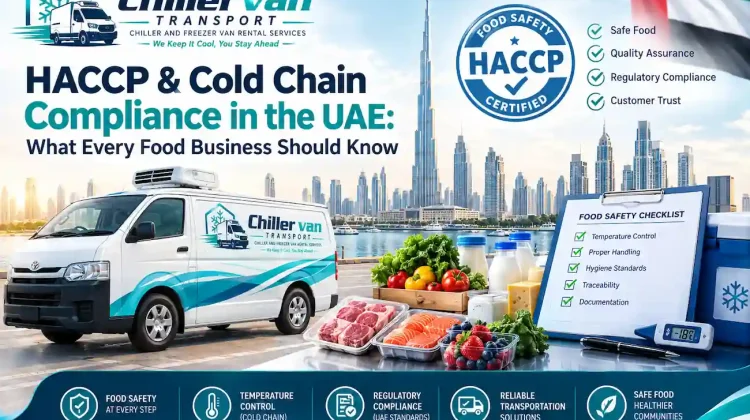
HACCP & Cold Chain Compliance in the UAE: What Every Food Business Should Know
IIf you move food in the UAE, compliance isn’t optional — it’s the law, and it follows your cargo all the way from the supplier’s door to your kitchen. Yet many businesses focus on their storage and kitchens while overlooking the riskiest link in the chain: transport.
This guide explains what HACCP actually means, who regulates food safety in the UAE, and what a compliant refrigerated delivery should look like.
What Is HACCP?
HACCP stands for Hazard Analysis and Critical Control Points. It’s an internationally recognised food-safety system that works by preventing problems rather than catching them after the fact.
The idea is simple:
- Identify where food could become unsafe (the hazards)
- Pinpoint the steps where you can control that risk (the critical control points)
- Set limits, monitor them, and keep records proving you did
For refrigerated transport, the critical control point is obvious: temperature. If the cold chain breaks — even briefly — bacteria multiply, and no amount of re-chilling undoes the damage.
Who Regulates Food Safety in the UAE?
Food safety in the UAE is handled at emirate level, with federal oversight:
- Dubai Municipality — Food Safety Department regulates food businesses and food transport in Dubai, including vehicle permits and inspections.
- ADAFSA (Abu Dhabi Agriculture and Food Safety Authority) performs the same role across Abu Dhabi emirate, including Al Ain and Al Dhafra.
- Other emirates have their own municipality food-control departments.
- MOCCAE (the Ministry of Climate Change and Environment) oversees food safety at federal level.
The practical upshot: vehicles carrying food need to meet hygiene and temperature standards, and inspectors can and do check them.
Note: rules and permit requirements change over time and differ by emirate. Always confirm current requirements with the relevant authority for your emirate — this guide is general information, not regulatory advice.
Why Transport Is the Weakest Link
Your cold room runs 24/7 and is easy to monitor. A vehicle, on the other hand, is exposed to:
- UAE heat — ambient temperatures that punish any weak refrigeration unit
- Door openings — every stop on a multi-drop route lets warm air in
- Traffic and delays — longer journeys mean more time in the danger zone
- Loading gaps — cargo sitting on a hot loading bay before it goes in
This is exactly why food-safety inspections pay close attention to transport, and why “we have a fridge in the van” is not the same as a compliant cold chain.
What Compliant Refrigerated Transport Looks Like
1. The right temperature, held the whole way
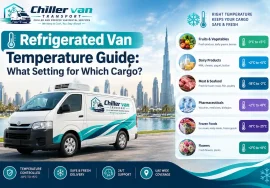
Chilled foods generally need 0°C to +8°C; frozen goods must stay at −18°C or colder. Different cargo has different requirements — dairy and seafood are far less forgiving than beverages. Our refrigerated van temperature guide sets out the correct setting for each cargo type.
2. Food-grade interiors
Vehicle interiors must be smooth, non-porous, easy to clean and free of damage that could harbour bacteria. No rust, no cracked panels, no lingering odours from the last load.
3. Pre-cooling before loading
A compliant vehicle is brought to temperature before the cargo goes in. Loading chilled goods into a warm van and hoping it catches up is one of the most common — and most serious — mistakes.
4. Separation of cargo
Raw meat must be kept apart from ready-to-eat foods. Chilled and frozen goods shouldn’t share a compartment. For mixed loads, use a dual-zone vehicle — a dual-zone refrigerated van or a dual-zone truck — which keeps each in its own insulated compartment at the right temperature.
5. Temperature monitoring and records
This is the part businesses most often miss. Compliance isn’t just being at the right temperature — it’s being able to prove it. Continuous logging creates an audit trail showing the cold chain held for the entire journey.
6. Cleaning and hygiene routines
Vehicles need documented cleaning between loads, and drivers need basic food-handling awareness. A clean vehicle with no records still looks non-compliant to an inspector.
A Simple Checklist for Your Business
Before you book any refrigerated transport, ask the provider:
- Are your vehicles HACCP-compliant?
- Do you pre-cool before loading?
- Can you provide a temperature log for my delivery?
- Are vehicles GPS-tracked?
- How do you separate different cargo types?
- How often are vehicles cleaned and maintained?
- Can you hold the specific temperature my product needs?
A serious provider will answer all seven without hesitation. If a quote is unusually cheap, these are usually the corners being cut — something worth weighing alongside the factors in our guide to chiller van rental cost in the UAE.
What Non-Compliance Actually Costs
- Spoiled stock — a single ruined pallet can wipe out the savings from a cheaper vehicle many times over
- Fines and penalties from the municipality or food authority
- Failed audits — many hotels, supermarkets and distributors require proof of cold-chain compliance from their suppliers
- Reputational damage — a food-safety incident is hard to recover from
- Health risk to the people eating your product
How We Keep Your Cold Chain Compliant
Every vehicle in our fleet — from chiller vans to refrigerated trucks — is HACCP-compliant, with food-grade interiors, pre-cooling before every dispatch, GPS tracking and continuous temperature monitoring that gives you a full record of the journey.
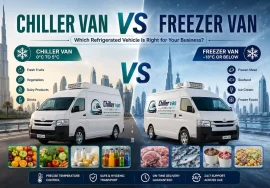
Not sure whether you need chilled or frozen? Our guide on chiller van vs freezer van explains the difference.
We serve all seven emirates, 24/7. Call +971 50 352 2176 or message us on WhatsApp to discuss your cold-chain requirements.rements.
Frequently Asked Questions
What does HACCP-compliant mean for a refrigerated vehicle?
It means the vehicle is operated under a food-safety system that identifies temperature as a critical control point — with food-grade interiors, pre-cooling before loading, defined temperature limits, continuous monitoring, documented cleaning, and records that prove the cold chain held throughout the journey.
Who regulates food transport in the UAE?
Food safety is regulated at emirate level — Dubai Municipality’s Food Safety Department in Dubai and ADAFSA in Abu Dhabi emirate, with other emirates covered by their own municipality food-control departments and federal oversight from MOCCAE. Requirements vary by emirate, so confirm the current rules with your local authority.
Do I need temperature records for my deliveries?
If you supply hotels, supermarkets, distributors or any audited business, you will almost certainly be asked to prove the cold chain held. Even where it isn’t demanded, continuous temperature logs protect you if cargo is ever disputed or an incident occurs.
What temperature does UAE law require for chilled and frozen food?
As a general rule, chilled foods are transported at 0°C to +8°C and frozen foods at −18°C or colder, with specific products having tighter requirements. Because exact limits are set by each emirate’s food authority and can change, check the current standard with your local regulator for your specific product.
Are all refrigerated van rental companies HACCP-compliant?
No. Some providers offer basic refrigerated vehicles without proper monitoring, pre-cooling routines or cleaning records. Always ask the questions in the checklist above before booking — especially whether they can supply a temperature log for your delivery.