
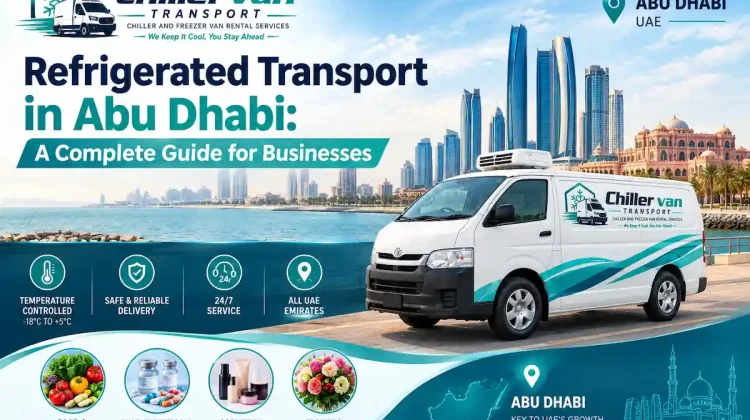
Refrigerated Transport in Abu Dhabi: A Complete Guide for Businesses
Abu Dhabi is the UAE’s largest emirate — a busy island capital, vast industrial zones, world-class hotels, a major deep-water port, and farmland stretching inland to Al Ain. Each of those needs a cold chain, and each needs something slightly different from it.
This guide covers what refrigerated transport in Abu Dhabi actually involves: which areas, which industries, which vehicle, and what to watch out for.
Why Abu Dhabi Is Different
Most cold-chain advice is written for Dubai. Abu Dhabi has its own challenges:
- Distance. The emirate covers well over half the UAE’s landmass. A delivery from Mussafah to Al Ain is a different job from a run across Dubai.
- Industrial scale. Mussafah, ICAD and KIZAD host serious food production and distribution operations — volumes here mean trucks, not just vans.
- Energy-sector logistics. Provisioning for oil-and-gas camps and facilities runs on strict schedules, often to remote locations.
- Agriculture. Al Ain’s farms and dairies feed much of the country, which means farm-to-market runs in the opposite direction from typical city logistics.
- Institutional demand. As the seat of government, Abu Dhabi has large-scale catering for hospitals, campuses and institutions.
Key Areas for Cold Chain Delivery
Mussafah & ICAD
The industrial heart of the capital. Food producers, processors and distributors cluster here, and most cold-chain routes in Abu Dhabi start or end in this area.
KIZAD & Khalifa Port
Khalifa Industrial Zone and the deep-water port make Abu Dhabi a genuine trade gateway. Temperature-sensitive cargo moves between the port, warehouses and distribution points — usually in bulk.
Abu Dhabi City & the Corniche
Hotels, restaurants, supermarkets and offices in the central district. Deliveries here are smaller, more frequent, and often time-boxed around traffic and loading restrictions.
Yas & Saadiyat Islands
Resorts, theme parks and leisure venues with high-volume kitchens and unforgiving delivery windows.
Khalifa City, MBZ City & the suburbs
Growing residential communities with supermarkets, grocery chains and restaurants needing daily replenishment.
Al Ain & Al Dhafra
Inland farms, dairies and the Western Region. Long routes, high ambient heat, and cargo that’s usually fresh rather than frozen. We cover this in detail on our chiller van rental in Al Ain page.
Which Vehicle for Which Job in Abu Dhabi?
Abu Dhabi’s mix of long distances and large volumes means trucks play a bigger role here than in a dense city like Dubai.
| Job | Best fit |
|---|---|
| Hotel & restaurant daily supply | Chiller van |
| Supermarket distribution across the emirate | Chiller truck |
| Frozen goods to camps, events or catering | Freezer van |
| Bulk frozen distribution & long-haul | Freezer truck |
| Chilled + frozen together in bulk | Dual-zone truck |
| Multi-stop city deliveries | Chiller van |
| Farm-to-market runs from Al Ain | Chiller van or chiller truck by volume |
If you’re weighing a van against a truck, our guide on refrigerated van vs refrigerated truck walks through capacity, distance and cost.
Industries We See Most in Abu Dhabi
Oil & gas provisioning — catering companies supplying camps and facilities need reliable, scheduled deliveries with full temperature records. Remote destinations and fixed timings leave no room for improvisation.
Hospitality — Yas, Saadiyat and Corniche hotels run large kitchens on tight delivery windows. Late or warm is not an option.
Ports & logistics — cargo moving through Khalifa Port and KIZAD often needs a temperature-controlled leg between vessel, warehouse and customer.
Agriculture & dairy — Al Ain’s producers moving milk, produce and dates to markets across the UAE.
Government & institutional catering — hospitals, universities and public institutions with volume requirements and compliance obligations.
Retail & food distribution — hypermarkets and grocery chains replenishing branches across the emirate daily.
Three Things That Catch Businesses Out
1. Underestimating distance
A run to Al Ain or out into Al Dhafra is hours, not minutes. That changes everything: fuel, driver hours, and how long your cargo sits in a vehicle fighting ambient heat. Plan for the route, not just the drop.
2. Choosing the wrong temperature band
Chilled and frozen are not interchangeable. Fresh produce, dairy and seafood each want a different setting, and frozen goods must never drift above −18°C. Our refrigerated van temperature guide sets out the right temperature for each cargo type.
3. Sizing the vehicle wrong
Booking a van for a load that needs a truck means multiple trips and higher total cost. Booking a truck for a few crates means paying for space you don’t use. Match the vehicle to the volume — the cost guide explains how that plays into pricing.
Compliance in Abu Dhabi
Food safety in Abu Dhabi emirate is overseen by ADAFSA (the Abu Dhabi Agriculture and Food Safety Authority), which covers Abu Dhabi city, Al Ain and Al Dhafra. Requirements can differ from Dubai’s, so confirm current rules with ADAFSA for your specific product and operation.
Whatever the emirate, the fundamentals are the same: HACCP-compliant vehicles, food-grade interiors, pre-cooling before loading, cargo separation, and temperature records that prove the cold chain held. We cover this in our guide to HACCP and cold chain compliance in the UAE.
Summer: Plan for the Heat
Abu Dhabi summers are brutal on refrigeration. Practical steps that make a real difference:
- Pre-cool the vehicle fully before loading — never load into a warm van
- Load in the early morning where you can
- Minimise door openings on multi-stop routes
- Don’t leave cargo waiting on a hot loading bay
- Build extra time into long inland runs
Get Moving in Abu Dhabi
We serve the whole emirate — Mussafah, ICAD, KIZAD, the city, the islands, Khalifa City, Al Ain and Al Dhafra — with HACCP-compliant, GPS-tracked, temperature-monitored vehicles, 24/7 with same-day dispatch.
See our full chiller van for rent in Abu Dhabi service, or call +971 50 352 2176 for a free quote.
Frequently Asked Questions
Do you provide refrigerated transport across all of Abu Dhabi emirate?
Yes. We cover Abu Dhabi city and the islands, the industrial zones at Mussafah, ICAD and KIZAD, Khalifa Port, Khalifa City and MBZ City, and inland to Al Ain and the Al Dhafra region, with 24/7 availability and same-day dispatch.
Do you have chiller trucks available in Abu Dhabi?
Yes. Chiller trucks hold 0°C to +8°C with full pallet capacity — ideal for supermarket distribution, catering and wholesale volumes across the emirate. For frozen bulk cargo, freezer trucks hold −18°C to −25°C, and dual-zone trucks carry chilled and frozen goods together.
Can you deliver frozen goods to remote sites and camps in Abu Dhabi?
Yes. Our freezer vans and freezer trucks hold −18°C to −25°C throughout the journey, and every vehicle is GPS-tracked with continuous temperature logging — which matters on long runs to remote destinations.
How much does refrigerated vehicle rental cost in Abu Dhabi?
Rentals start from AED 250 per day and from AED 3,000 per month. The exact price depends on vehicle type, rental duration and route — longer inland runs to Al Ain or Al Dhafra are priced differently from city deliveries.
Who regulates food transport in Abu Dhabi?
ADAFSA — the Abu Dhabi Agriculture and Food Safety Authority — oversees food safety across Abu Dhabi emirate, including Al Ain and Al Dhafra. Requirements change over time, so check current rules with ADAFSA for your specific product.